Salary Sacrifice Car Schemes: Why Scottish Taxpayers Often Save More
.jpg)
Same salary, same car, same scheme. A Scottish taxpayer can end up over £1,000 a year better off than someone earning the same wage elsewhere in the UK.
Salary Sacrifice Car Schemes: Why Scottish Taxpayers Often Save More
If you're weighing up a salary sacrifice car scheme and you're based in Scotland, where you live changes the numbers more than most people realise. Scotland sets its own income tax bands, separate from the rest of the UK, and the gap between the two systems can mean a meaningfully bigger saving on exactly the same car and the same salary.
How salary sacrifice actually works
Your employer arranges a leased vehicle, and instead of paying for it out of your take-home pay, the cost comes off your gross salary before tax and National Insurance are calculated. You pay tax on a smaller salary, and separately pay a small amount of Benefit in Kind (BIK) tax on the car itself. For most people, especially in an electric vehicle, the tax and NI saved comfortably outweighs the BIK charge.
Why your address matters more if you're in Scotland
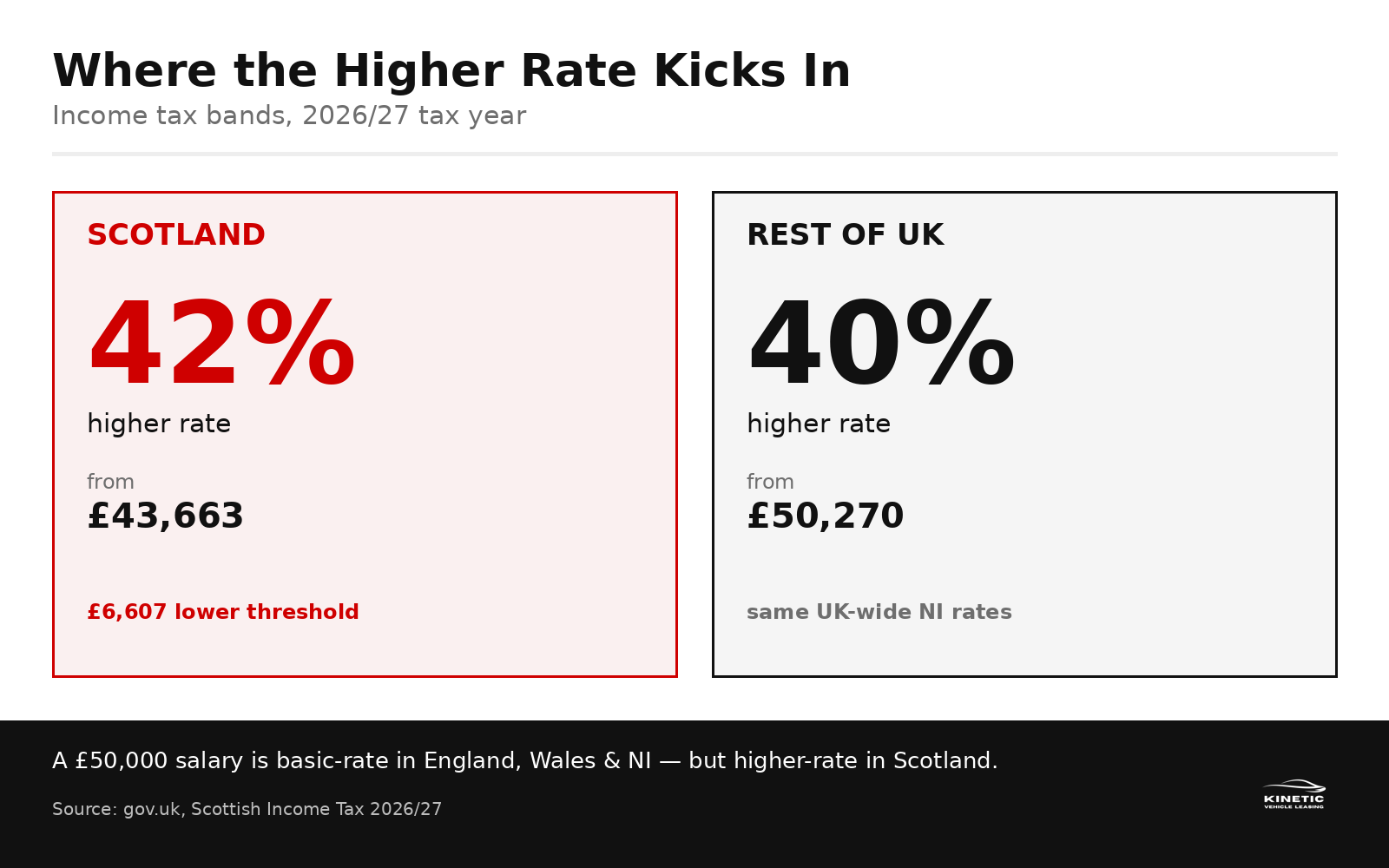
Scotland has six income tax bands for 2026/27. The rest of the UK has three. The one that matters most for salary sacrifice is the higher rate.
| Scotland | Rest of UK | |
|---|---|---|
| Higher rate threshold | £43,663 | £50,271 |
| Higher rate | 42% | 40% |
That £43,663 threshold means a lot of Scottish earners are already higher-rate taxpayers well before they'd be classed as one anywhere else in the UK. National Insurance is the same across the whole of the UK (8% up to £50,270, 2% above), so the difference comes entirely from income tax.
A worked example
Take someone earning £50,000 a year, sacrificing £500 a month (£6,000 a year) for an electric vehicle with a P11D value of £35,000.
In Scotland, £50,000 falls in the 42% higher rate band.
- Income tax saved on the sacrificed salary: £6,000 × 42% = £2,520
- NI saved: £6,000 × 8% = £480
- BIK tax payable (EVs are taxed at just 4% of P11D value in 2026/27): £35,000 × 4% = £1,400, taxed at 42% = £588
- Net annual saving: £2,412
In the rest of the UK, the same £50,000 salary is still in the 20% basic rate band, since the higher rate doesn't start until £50,271.
- Income tax saved: £6,000 × 20% = £1,200
- NI saved: £6,000 × 8% = £480
- BIK tax payable: £1,400 taxed at 20% = £280
- Net annual saving: £1,400
Same salary, same car, same scheme. The Scottish taxpayer is over £1,000 a year better off, purely because of where they live.
Why electric vehicles specifically
The BIK rate on fully electric cars is 4% for 2026/27, rising gradually to 9% by 2030, but still far below the 17% to 37% range that applies to petrol and diesel cars. That low BIK charge is a big part of why salary sacrifice savings on EVs tend to be so much stronger than on a conventional car, in Scotland or anywhere else.
What this means for you
If you're an employer anywhere in Scotland weighing up whether to offer salary sacrifice, this is worth putting in front of your team directly. A benefit that saves a higher-rate Scottish taxpayer over £200 a month against their normal running costs tends to land well, and it costs the business nothing beyond the administration of setting the scheme up.
Figures are based on 2026/27 Scottish and UK-wide tax rates and are for general illustration only, not individual tax advice. Your own saving will depend on your specific salary, tax position, and chosen vehicle. We'd always recommend checking your personal circumstances with your employer's payroll team or a tax adviser before signing up to a scheme.
If you're an individual considering it, the exact saving depends on your salary, tax band, and the specific vehicle, so it's worth getting a personalised figure rather than working off a general example.
Get in touch on 0330 202 0973 or enquiries@kineticleasing.co.uk and we'll run the numbers for your situation.